"the necessity of removing the Lighthouse at Block Island, or of building a new one, it
having become dangerous to reside in the old house in its present situation."
In 1836 a wall was built to protect the lighthouse. This was a stopgap until a new lighthouse was built.
In 1837, a granite lighthouse was built further inland. The new Block Island North Lighthouse also had two towers, one was on the north end and the other was on the south end. The illuminating apparatus in each tower consisted of seven lamps with fifteen inch reflectors.
Lieutenant George M. Bache's 1838 inspection report praised the construction of the new Block Island North Lighthouse. He stated, "the walls are of granite, well laid in cement; and justice appears to have been done it throughout by the contractor."
A strange thing happened after the new lighthouse was built; the number of shipwrecks near the it increased. The cause of the increase was thought to be a combination of bad luck and an increase in shipping traffic. It was later determined that the lighthouse had been built too far inland and was causing ships to run aground
In 1857, a brick Block Island North Lighthouse and keeper's house was built a third of mile north of the old lighthouse. The lighthouse and keeper's house were connected, and were both painted white. The lighthouse was square. Each wall was fourteen feet long. It was equipped with a fourth order Fresnel lens. This light was soon threatened by erosion too. A new light was needed.
| Sketch of 1857 Frame Proposed Block Island North Light |
|---|
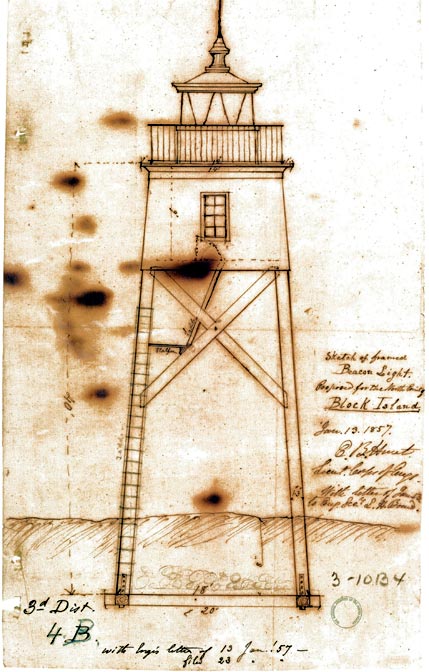 |
| National Archives ID 79436913 |
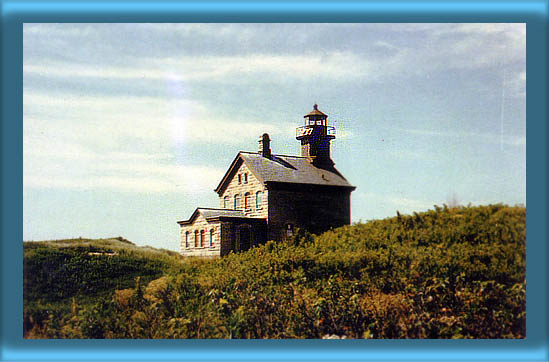
The present light, a granite keeper's dwelling with a tower attached to the roof, was built in 1867. It was equipped with a fourth order Fresnel lens, and was first lighted on September 15, 1867. The old Block Island North Lighthouse was torn down. Materials from it were used to protect the new site against the destructive action of the wind.
After just five years the lighthouse was in danger again. High winds had caused a chasm to develop in the sand near the lighthouse. The problem was fixed by grading the land around the lighthouse and covering it with paving stones.
Block Island North Lighthouse was automated in 1955. In 1973 the Coast Guard closed the lighthouse and replaced it with a light on a skeleton tower.
The town of New Shoreham acquired the lighthouse in 1984. After years of hard work the light was relighted on August 5, 1989. The lighthouse is maintained by the North Light Commission.
In 2001 an inspection discovered the iron tower on the lighthouse was in need of repairs. The cost to repair it and the roof was $700,000. The lighthouse was closed in 2003 and was replaced with a skeleton tower. The money to repair it was raised through grants and donations.
In 2010, after years of work, the restoration of Block Island North Lighthouse was completed. The lighthouse's 1867 fourth order Fresnel lens was reinstalled in the light. On October 23, 2010, a cool moonlit night, the lighthouse was relighted as a private aid to navigation.
See more of Block Island North Lighthouse in Rhode Island Lighthouses: A Pictorial History by R Holmes.
For information
on the Block Island North Lighthouse, contact:
North Light Commission
P.O. Box 220
Block Island, RI 02807
North Light Commission
P.O. Box 220
Block Island, RI 02807