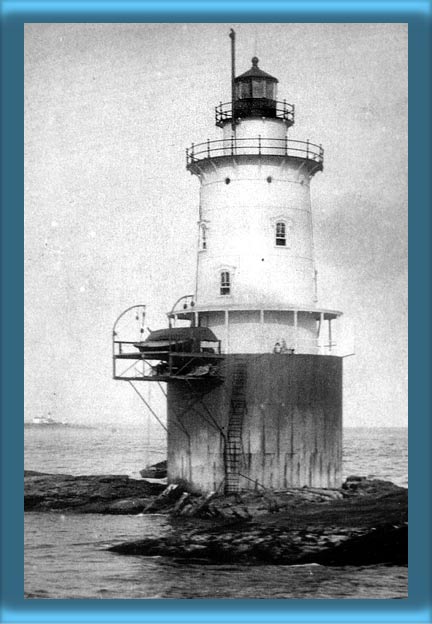
In the following years several more ships struck Whale Rock, including the schooner Robin. It was transporting 210 tons of coal from Weehawken, New Jersey to New Bedford, Massachusetts. On November 20, 1875, the ship hit Whale Rock and sank in less than five minutes. The crew barely got off the ship. George W. Fife, Dutch Island Lighthouse's keeper heard their cries and rescued them. He took them to Dutch Island for the night. The Robin was a total loss.
| Petition For Whale Rock Lighthouse |
|---|
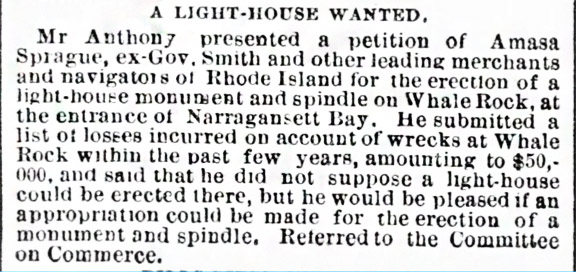 |
| Boston Post (Boston, MA) February 25, 1876 |
The Providence Journal published an editorial in 1876 on the desperate need for a lighthouse on Whale Rock. The editorial stated, "There is not another place so dangerous and exposed a place on the whole coast, from Cape Cod to the Capes of Delaware." It gave a list of eight ships and the lives lost on them. The first ship it listed was the schooner Pearl. It struck Whale Rock on a cold night in January 1867. The ship went down immediately with four men and a boy. The ship's captain came to the surface and lashed himself to the mainmast until he was rescued the next day.
The editorial listed seven other ships that hit Whale rock. The sloop Dart hit the rock and sank with all hands. She was a total loss.The schooner Lonsdale from Baltimore was wrecked on the rocks and sank. There were only two survivors. The schooner Isreal H. Day hit the rock and sank with all hands on board. The schooner Herriss, the steamer Oceanus, the schooner Elisha Brook and the Jubex L. White all sank after hitting the Whale Rock, but with no loss of life.
Most of the ships lost on Whale Rock were small coastal sloops and schooners, worth $5,000 to $10,000, manned by five or ten sailors. If their sinking made it into the newspapers, it would be a small article in Rhode Island, Massachusetts or Connecticut newspapers. On November 6, 1880, the steamship Rhode Island, one of the finest ships in the Providence Line, hit Whale Rock at 3:15 in the morning. There were 170 passengers on board. The ship was able to ground it self on Bennentt Point near Beavertail. All the passengers and crew survived. The Rhode Island, valued at $500,000, was a total lost.
On February 25, 1881, Representative Nelson W. Aldrich from Rhode Island's first district, introduced a bill to appropriate $35,000 to build Whale Rock Lighthouse. The money was appropriated March 3, 1881. Construction started a few months later.
Building the light wasn't easy. Work could only be done at low tide and calm seas. Only the light's foundation was finished before autumn storms forced construction to stop. Even in calm seas working on Whale Rock was dangerous. Waves would suddenly wash over the rock. One time a wave washed the master mechanic off the rock. As the lighthouse was nearing completion, an article describing its interior appeared in the August 5th, 1882 edition of the Newport Mercury.
"There are six spacious rooms in the tower. The lower one being the largest, will be dedicated for a general living room. The one above is intended for a sitting room or parlor; then above are three rooms, 12 feet in diameter, of course as round as the tower, intended as sleeping apartments. Above these is another room, named the watch room. Each chamber is fitted with closets and other necessary accommodations."
Whale Rock lighthouse was completed in 1882. On October 1 tenders from New York and Block Island went to Whale Rock with the lamps and other equipment for the lighthouse. They also brought Nathaniel Dodge, the light's first keeper. The lamps and lens were installed and lighted that night.
| Whale Rock Lighthouse's First Light 1882 |
|---|
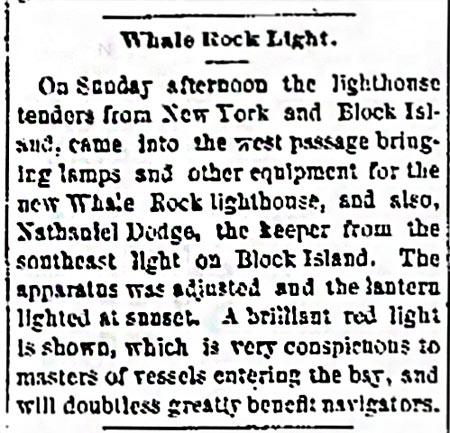 |
| Newport Mercury (Newport, RI) October 7, 1882, |
On August 1, 1901, Whale Rock had an unusual visitor. Keeper Stanton was clearing out his boat, when he heard a hissing sound. He saw a snake coiled on a rock. He picked up a stick and killed the snake. Stanton was at a loss, how the snake reached Whale Rock a mile from land.
Working at Whale Rock Lighthouse was dangerous. Doing something as simple as getting the mail could get you killed. On December 26, 1901, Keeper Nathan Eckman went to Narragansett Pier to get the mail and supplies. While returning to the light, his boat was capsized by heavy seas. Eckman drowned. The mail later washed on the rock and was recovered.
Five years later another Whale Rock Lighthouse keeper, John S. Ihael, had his boat capsize in heavy seas. He managed to cling to the top of the overturned boat. He was rescued by a crew from the Narragansett Life Saving Station.
An article, "Meteorite Fell Into Sea" in the May 31 1902 edition of the Boston Globe tells about an unusual event at Whale Rock Lighthouse. On May 30 Keeper J. G. Mead saw a large meteorite fall into the water 300 yards south of the lighthouse. When it hit the water, it exploded. The explosion was heard two miles away
On September 21, 1938 Whale Rock's keeper Daniel Sullivan went ashore to get supplies. The assistant keeper, Walter Eberle, was left in charge of the light. The former navy man had been with the Lighthouse Service for just a year. While Sullivan was ashore the 1938 Hurricane hit Rhode Island and prevented him from returning to the light.
Whale Rock Light was hit repeatedly by waves that grew bigger as the storm grew stronger. Eberle probably took refuge in the lighthouse's top floor. Keepers at similar lighthouses in the area rode out the storm in the top floor, as the sea smashed out the sash windows on the lower floors, but did not break the port holes on the top floor. After hours of this punishment, the metal lighthouse reached its breaking point. A huge wave hit the lighthouse and tore off the lantern, watch room and the light's top two stories, killing Eberle. His body was never found. He left a wife and six children. The bottom two floors collapsed into the base, shortly after the hurricane ended. An examination of the remains of the lighthouse found books, shoes, clothing, and a made-up bed still intact.
Over the years there'd been speculation that Whale Rock Lighthouse wasn't fastened to its base. One keeper even put this belief into the lighthouse's log. Some local residents believed this was the reason the lighthouse was destroyed. On November 9, 1938, the 2nd District Associate Engineer visited the remains of Whale Rock Lighthouse to find out why it was destroyed. During the examination of its concrete base, he discovered the lighthouse wasn't fastened to the base. He found "no evidence of anchor bolts or any other means by which the cast iron tower plates were actually held to the masonry pier, except for the brick tower lining, which appeared to be 8 inches thick at the bottom, and the mass of the entire tower." This wasn't the reason the lighthouse was destroyed, though. The engineer found some of the bolts holding the lighthouse's cast iron plate together were corroded. This weakened its structural integrity. The repeated pounding of the waves on September 21 jarred the corroded bolts loose and tore the top off.
On September 28, 1938, a type 9-38-W buoy was placed 300 yards east from Whale Rock. This new navigation aid was named Whale Rock Lighted Whistle Buoy 3. The people of Jamestown complained that it emitted "a most mournful depressing sound." They wanted it changed to either a lighted gong or bell buoy. The buoy was later changed to a gong buoy. In 1940 what remained of the lighthouse was removed from the base. A 30 foot skeleton tower and light was placed on the base. It cost $5200 to build the tower. The light was extinguished during World War II so it couldn't be used as an aid to navigation by German U-boats. The light was removed in the 1950's.
In 2004 David Robinson, an undersea archeologist with the Public Archeology Lab in Pawtucket, Rhode Island, located the metal remains of the lighthouse. He said, the seabed was scattered with "millions of pieces of metal, some as big as desks.
Today all that remains of Whale Rock Lighthouse are the remnants of the foundation. It's gradually disintegrating. The photographs from 2000 to 2013 shows how much has been lost. In fifteen or twenty years it will be gone.
| Whale Rock Lighthouse in 1900 |
|---|
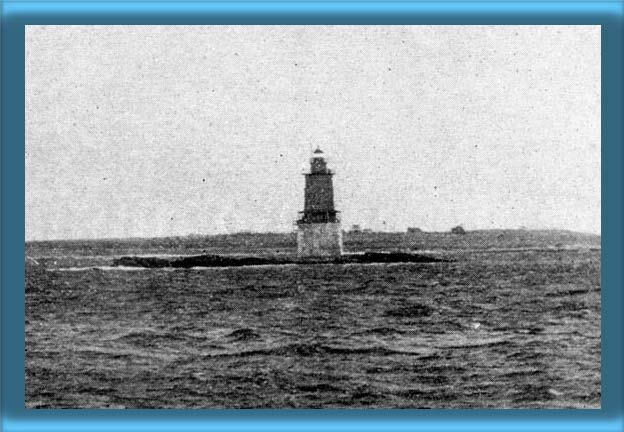 |
| Courtesy of N.L. Stebbins |
| U.S. Lighthouse Society News Wickie from NH The Light Hearted Podcast ep 265 February 18, 2024 Whale Rock, RI, and the Hurricane of 1938 |
|---|