 |
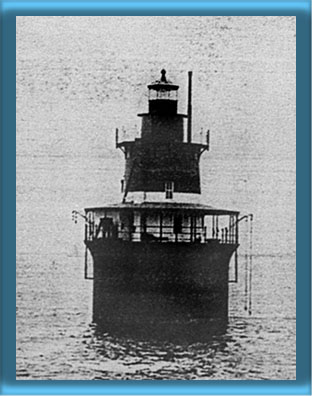
Courtesy of the National Archives |
| |
Courtesy of the National Archives |
Location: West
Passage of Narragansett Bay near the Jamestown Bridge
 1897 - present --Lat 41
31 51 N - Long 71 24 19 W
1897 - present --Lat 41
31 51 N - Long 71 24 19 W
Established: 1897
Lighthouse Constructed:
1897 - 1899
Deactivated: 1941 - 2003
Reactivated: 2003
Original Illuminating
Apparatus: Fourth Order Fresnel lens
Current Illuminating
Apparatus: Solar Powered Beacon
Height: 53 feet
Status: Restored/Private Aid To Navigation
Light Characteristic:
Flashing White every 5 seconds
(1906)
 Flashing White every 5 seconds (2005)
Range: 12 miles (1906)
 3 miles (2005)
In 1895 and 1896 Congress appropriated a total of $60,000 to
build a lighthouse and fog signal on Plum Beach Shoal. Captains
of ships using the West Passage of Narragansett Bay had been asking
for a light at Plum Beach for a number of years. In foggy weather
ships avoiding Dutch Island would sometime sail too far west and
go aground on the shoal.
In 1896 a pneumatic caisson, an air tight
square wooden structure, with the lower part of Plum Beach light's
thirty-three foot diameter metal foundation attached to it, was
towed from Providence to Plum Beach and was sunk. Once the caisson
settled to the bottom, the water inside was pumped out and it
was filled with air. Workers went into caisson and removed the
soil underneath it, allowing it to sink to thirty-eight feet below
mean low water. As it sank, metal plates were added to the top
of the foundation. In early December, a test boring showed a seven-foot
layer of quicksand at the thirty-eight foot depth. If the caisson
was left at this depth the lighthouse would be unstable. The caisson
would have to placed seven feet deeper. This also meant that the
foundation would have to be heightened but there wasn't enough
money in the budget to do that. The lighthouse Board stopped construction
on the light. The top of the unfinished foundation was covered
with wood and a temporary red lantern was placed on it.
In 1898, $9,000 was appropriated to complete the light. An additional
row of metal plates was added to the foundation, before weather
halted work in January 1899. In April work resumed on the lighthouse.
It was finally finished on June first. A fourth order Fresnel
lens was installed in the lighthouse and it was first lighted
on July 1, 1899.
On September 21, 1938, substitute keeper Edwin Babcock tried to
row ashore to see his family but wind and high waves caused by
the approaching 1938 Hurricane forced him back to the lighthouse.
He and assistant keeper John Ganze knew a bad storm was coming.
They secured the light and waited. As the storm grew in intensity,
the light was hit by bigger and bigger waves. A thirty-foot wave
hit the lighthouse and tore open the kitchen door. Water poured
into the lighthouse. The keepers climbed up to the fog bell room.
It was the highest, non-exposed point on the light. They tied
themselves, back to back; to the pipe containing the weights that
turned the Fresnel lens in hope their bodies would be found together
if the lighthouse were destroyed. The keepers survived, but the
light was badly damaged. Minor repairs were made to the lighthouse
and it was put back into service.
In 1941, the first Jamestown Bridge was built almost on top of
Plum Beach Light. The lighthouse was no longer needed as an aid
to navigation and was closed. The Coast Guard put the lighthouse
up for auction. The high bidder would have to tear it down and
remove it. No one bid on it.
The Cannon Paint Company of Philadelphia was hired to paint the
Newport Bridge in 1973. James Osborn, Cannon employee, was taken
off his job painting the bridge and was ordered to paint Plum
Beach Lighthouse. While he was painting the lighthouse, he contracted
histoplamosis, an eye disease, from pigeon feces that filled the
lighthouse. In 1984 he sued the state for $500,000. The case was
in court for years.
In 1988 O'Connell Development of Quincy, Massachusetts wanted
to move Plum Beach Lighthouse to a breakwater at Marina Bay, its
condominium development in Quincy. There was a problem; they could
not find the owner. The Coast Guard said ownership of the lighthouse
reverted to Rhode Island when they abandoned it. The Rhode Island
Attorney General's Office disagreed. It said, the Coast Guard
may have abandoned the lighthouse, but it never gave the state
the title. Without a title, the state does not own it. Neither
side wanted to claim the lighthouse, because of the lawsuit. O'Connell
Development later hired an architect to plan a lighthouse from
scratch.
The Friends of Plum Beach Lighthouse, Inc. was formed in response
to O' Connell Development's attempt to buy the lighthouse. The
group wanted to acquire the light and restore it. Their efforts
to get the lighthouse were frustrated for a number of years because
of the uncertain ownership.
In 1998 the Rhode Island Superior Court decided that the state
owned the light. The court ordered the state to pay $42,000 to
James Osborn. With the question of ownership finally resolved,
the state decided to give the Friends of Plum Beach title to the
lighthouse.
In 2003 Abcore Restoration started on the restoration of the lighthouse.
The first step of the restoration was the removal of over 50 tons
guano left by the birds that lived in the lighthouse. After the
interior was cleaned out the lighthouse exterior was repainted
and repaired. In December a new light was placed in the lighthouse
and Plum beach lighted for the first time in 62 years.