 |
| |
Location: East side
of Providence River near Providence
 1874 - present
  Lat 41
47 38 N - Long 72 22 49 W
Lat 41
47 38 N - Long 72 22 49 W
Established: 1874
Lighthouse Constructed:
1874
Removed: 1924
Original Illuminating
Apparatus: Six-Order Fresnel lens
Current Illuminating
Apparatus: 250 mm lens
Height: Lighthouse: 14 feet (1906)
 Skeleton tower: 25 feet (2005)
Status: Active aid to navigation/ skeleton tower
now named Channel Light 42
Light Characteristic:
Lighthouse: Fixed Red (1906)
 Skeleton tower:
Flashing Red 6 seconds (1988)
Skeleton tower:
Flashing Red 6 seconds (1988)
 Isosphase Red 6 seconds (2005)
Range: Lighthouse: 7½ miles (1906)
 Skeleton tower:
5 miles (1988)
Skeleton tower:
5 miles (1988)
 4 miles (2005)
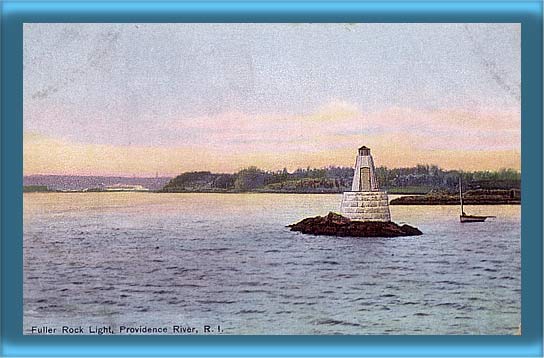
The granite pier that supports Channel Light 42 is all that remains
of Fuller Rock Light. The wooden hexagonal shape light was constructed
in 1872 on the east side of the Providence. Its keepers were responsible
for it and Sassafras Point Light on the west side of the Providence
River.
It was difficult finding suitable keepers for them because of
the low pay rate for tending these kinds of lights. The Lighthouse
Board wanted to build a keeper's dwelling near the lights, as
an offset to the low pay. In 1874, Congress appropriated $5,000
for it, but it was never built. The land near the lights was being
improved for business purposes. The property owners didn't want
to sell it to the government, as they feared it would reduce the
surrounding land value.
In 1886, Captain Jack Mullen was appointed the keeper for Fuller
Rock and Sassafras Point, a position he would hold for 25 years.
Just before sunset he would row out to Fuller Rock first and light
it. Sometimes during the winter, it would be covered with ice.
He would have to crawl on his hands and knees to reach the light.
After it was lit, he would row up the river to Sassafras Point
and light it. He would repeat this process the next morning to
extinguish them.
On February 5, 1923, the lighthouse tender Pansy arrived at Fuller
Rock to replace its six acetylene tanks. The light had been changed
from oil to acetylene when it was automated in 1918. The crew
from the Pansy removed the old tanks and installed six new ones.
Each tank was six feet long and weighed over 200 pounds. After
the installation was completed, the crew returned to the Pansy
for lunch.
After lunch, the crew returned to the light to make sure everything
was all right. As they climbed the stairs to the light, it exploded
throwing the men onto the surrounding rocks, injuring five of
them. The wreckage burst into flames, completely destroying what
was left of it. The explosion was so powerful it was heard a mile
away.
The Pansy rushed its five injured crewmembers to Providence for
treatment. A buoy was placed near Fuller Rock as a temporary aid
to navigation. A light on a skeleton tower was later erected on
the granite pier.