 |
© 2004 R. Holmes |
| |
© 2004 R. Holmes |
Location: Entrance
to East Passage of Narragansett Bay
 1890 - present
  Lat 41
27 44 N - Long 71 21 47 W
Lat 41
27 44 N - Long 71 21 47 W
Established: 1890
Lighthouse Constructed:
1890
Automated: 1957
Original Illuminating
Apparatus: Fifth Order Fresnel Lens
Current Illuminating
Apparatus: 300-mm Lens
Height: 34 feet
Status: Active Aid to Navigation
Light Characteristic:
Flashing Red every thirty seconds (1906)
 Isophase Red every six seconds
(2005)
Isophase Red every six seconds
(2005)
Range: 11½ miles (1906)
 12 miles (2005)
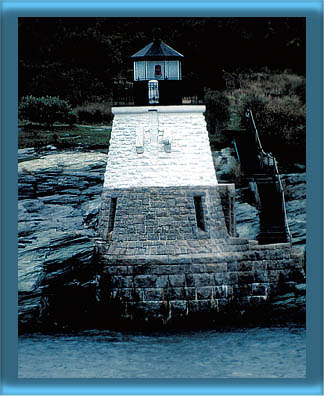
In 1869 an application was made for a lighthouse at Castle Hill
in Newport. After examining the area, the Lighthouse Board recommended
that a light and a fog signal be built there. The Board requested
an appropriation of $18,000 to build it. Congress didn't appropriate
the money. The request was renewed the following year and was
again denied. The Lighthouse Board didn't renew their request
in 1871.
On March 3, 1875, Congress appropriated $10,000 for a fog signal
at Castle Hill. A site was chosen, but couldn't be purchased.
The property owners had built mansions for summer residences and
felt that the fog signal would lower their property values. The
Board looked for a new site in the area, but couldn't find a suitable
site. After two years of unsuccessfully trying to acquire the
site, the Lighthouse Board considered placing a whistle buoy off
the point instead. But because of the sheltered character of the
position its success was doubtful. The buoy was never placed on
the site
In 1886, the Lighthouse Board tried to build the lighthouse again.
The following year one of the property owners, Alexander Agassig,
sold them the land for the light for $1.00. On October 20, 1887
the bids to build the lighthouse and fog signal were opened. William
Wilbur was the low bidder, but this was on the condition he was
allowed a right of way to the proposed site. Agassig refused to
give them one. It took nearly two years of negotiations before
he relented and deeded a .198 acre right of way. Construction
started on the light later in the year and was completed in 1890.
It was first lighted on May first. A six-room keeper’s dwelling
was built on at the nearby Castle Hill Cove.
Castle Hill Light survived the 1938 Hurricane without serious damage. In 1957 the light was automated and its Fresnel lens was replaced with a 300-mm plastic lens. The light is still an active aid to navigation.