 |
| |
Location: North
End of Block Island
 1867 - present
  Lat 41
13 42 N - Long 71 34 36 W
Lat 41
13 42 N - Long 71 34 36 W
Established: 1829
Original Lighthouse
Constructed: 1829
Current Lighthouse
Constructed: 1867
Automated: 1955
Deactivated: 1973 -1989
Original Illuminating
Apparatus: Fourth Order Fresnel Lens
Current Illuminating
Apparatus: VBR
25
Height: Lighthouse:
52 feet
 Skeleton tower: 20 feet (1973 - 1989)
Status: Active Aid to Navigation/Interpretive
Center
Light Characteristic:
Lighthouse: Fixed White (1906)
 Group Occulting (3) White every 13.5 seconds (1924)
2 seconds flash, 1.5 seconds eclipse
2
seconds flash, 1.5 seconds eclipse
5 seconds flash, 1.5 seconds eclipse
Flashing White every 5 seconds (2005)
 Skeleton tower: Flashing White
every 5 seconds (1973 - 1989)
Skeleton tower: Flashing White
every 5 seconds (1973 - 1989)
Range: Lighthouse:
13 miles (1906)
 13 miles (2005)
 Skeleton tower: 13 miles (1973 - 1989)
The first Block Island North Light was built at the Northern tip
of Block Island in 1829. It had two towers, one at each end of
the light. After a few years, erosion threatened to bring the
lighthouse down.
In 1837, a granite lighthouse was built further inland. It also
had a tower at both ends of the keeper's dwelling. The illuminating
apparatus in each tower consisted of seven lamps with parabolic
reflectors.
Erosion, a constant problem at the northern tip of Block Island,
also threatened the second light. In 1857, a granite tower was
built farther inland. It was equipped with a fourth order Fresnel
lens. This light was soon threatened by erosion too. A new light
was needed.
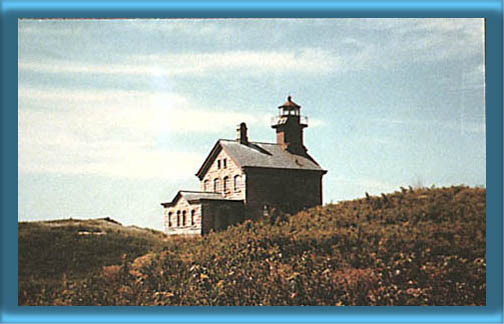
The present light, a granite keeper's dwelling with a tower attached
to the roof, was built in 1867. It was equipped with a fourth
order Fresnel lens. The light was automated in 1955. In 1973 the
Coast Guard closed the lighthouse and replaced it with a light
on a skeleton tower.
The town of New Shoreham acquired the light in 1984. After years
of hard work the light was relighted on August 15, 1989. Today
the light once again serves an active aid to navigation. The light
is maintained by the North Light Commission. During the summer
visitors can visit a museum on the first floor of the light and
see the light's Fresnel lens.