 |
© 2004 R. Holmes |
| |
© 2004 R. Holmes |
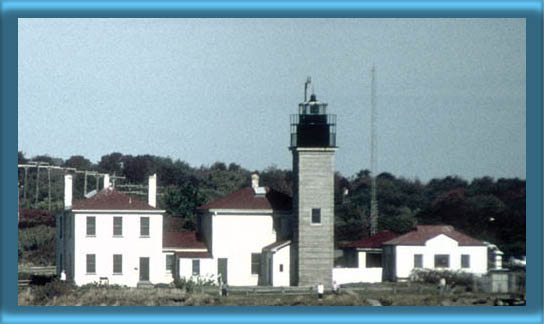
Location: Beavertail
Point on the southern tip of Conanicut Island
 1749 - present
 Lat 41
26 58 N - Long 72 23 59 W
Lat 41
26 58 N - Long 72 23 59 W
Established: 1749
Original Lighthouse
Constructed: 1749
Current Lighthouse
Constructed: 1856
Automated: 1972
Original Illuminating
Apparatus: Third Order Fresnel Lens
Current Illuminating
Apparatus: DCB
24
Height: 45 feet
Status: Active Aid to Navigation/Museum in Assistant
Keeper's Dwelling
Light Characteristic:
Group flashing (8) White every 30 seconds (1924)
 0.7
seconds flash, 1.2 seconds eclipse
0.7
seconds flash, 1.2 seconds eclipse
0.7 seconds flash, 1.2 seconds eclipse
0.7 seconds flash, 1.2 seconds eclipse
0.7 seconds flash, 1.2 seconds eclipse
0.7 seconds flash, 1.2 seconds eclipse
0.7 seconds flash, 1.2 seconds eclipse
0.7 seconds flash, 1.2 seconds eclipse
0.7 seconds flash, 16 seconds eclipse
Group flashing (2) White every 15 seconds
(1950)
0.4 seconds flash, 3.2 seconds eclipse
0.4 seconds flash, 11 seconds eclipse
Flashing White every 6 seconds (2005)
Range: 15 miles
The first lighthouse in Rhode Island, a fifty-eight feet wood
conical tower, was built at Beavertail Point on the southern tip
of Conanicut Island. The light was designed by Peter Harrison,
who later designed the Touro Synagogue in Newport. When it was
built in 1749, it was only the third lighthouse in America. It
burned down in 1751.
The second Beavertail Light was built in 1754 using rubble stone.
The British set fire to the light, when they were forced out of
Rhode Island in 1779. The light's keeper's dwelling was destroyed
during a hurricane in September 1815. A new keeper's dwelling
was built in 1816.
In 1856, the current light station, a granite tower and a brick
keeper's dwelling, was built. A third order Fresnel lens was installed
in the new tower. It was first lighted on October 20, 1856. A
few days later the old light was blown up.
On September 21, 1938 one of the most powerful hurricanes in history
hit Rhode Island. As the storm raged, a school bus carrying Beavertail
Light's keeper Carl Chellis' son, Clayton, and daughter, Marion,
and six other children drove to the light. The bus was crossing
a causeway at Mackerel Cove, when a storm surge hit. The bus was
swamped. The school bus driver, Norman Caswell, feared they would
all drown if they stayed on the bus. He and the children got off
the bus and headed to high ground. Another storm surge hit and
swept them away. Only the Bus Driver and the lighthouse keeper's
son survived. As the Bus Driver was being pulled form the water,
he pleaded "Please let me die, I lost all those bunch of
kids. Everything's gone. Please don't move me from the water.
Let me die!"
The 1938 Hurricane tore up the ground in front of light and revealed the stone foundation of the first Beavertail light. In 2008 a radar survey of the foundation
was done. It was believe that the first Beavertail light was circular in shape. The survey determined that the light was
octagonal in shape. There are no images of it, but Poplar Point Lighthouse in Wickford was built with an octagonal
shape tower.
The light was automated in 1972. In 1991, the fourth order Fresnel lens, installed in 1907, was replaced
by a modern optic. Today Beavertail still serves as an active
aid to navigation. The Beavertail Lighthouse Museum has a small
museum in the assistant's keeper's dwelling. Its centerpiece is
the fourth order Fresnel lens used at the light. The museum is
open from Memorial Day thru the middle of October.