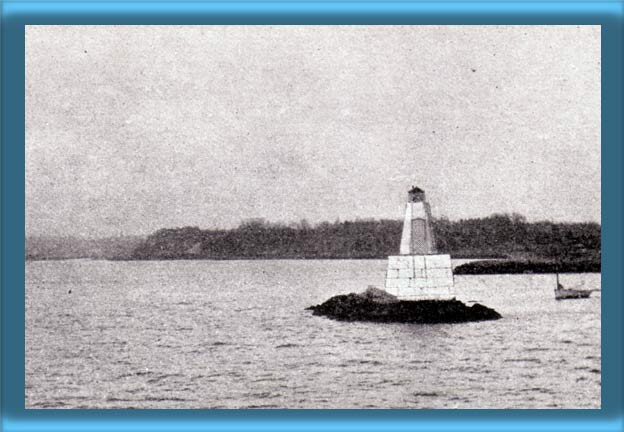
It was difficult finding suitable keepers for them because of the low pay rate for tending these kinds of lights. The Lighthouse Board wanted to build a keeper's dwelling near the lights, as an offset to the low pay. In 1874, Congress appropriated $5,000 for it, but it was never built. The land near the lights was being improved for business purposes. The property owners didn't want to sell it to the government, as they feared it would reduce the surrounding land value.
In 1886, Captain Jack Mullen was appointed the keeper for Fuller Rock and Sassafras Point, a position he would hold for 25 years. Just before sunset he would row out to Fuller Rock first and light it. Sometimes during the winter, it would be covered with ice. He would have to crawl on his hands and knees to reach the light. After it was lit, he would row up the river to Sassafras Point and light it. He would repeat this process the next morning to extinguish them.
In the early 1900s the Providence River would often freeze up in the winter. On the morning of February 14, 1912 people living in Kettle Point, a neighborhood in East Providence, Rhode Island, saw a ghost like figure walking on Fuller Rock. An article in the February 15, 1912 edition of the Fall River Globe described is as , "the apparition was supposed to be a woman, being clad in a long, clinging garment, with white folds flapping in the freezing wind which blew down the harbor." It also had a white night cap on its head.
The people in the neighborhood thought it was an escaped lunatic. The mayor was called to the location. He thought the police should be called. The other people in the neighborhood had different ideas how to deal with it. Captain Joe Sweet said they should find out if a female lunatic had escaped during the night. Captain Jake Brown thought it would be a good idea to shoot it, to see if it was real.
Captain Edward Grogan, Fuller Rock's keeper, had to go out to the lighthouse to turn the light off. He said he would find out what it was. He stepped out onto the ice and pushed his boat toward the lighthouse. As he got near the lighthouse, a male voice call out "Is it cold enough for you this morning."
With his boat hook ready, he continued to the lighthouse. The figure stood up and greeted him. It was a man duck hunting. He was dressed in his wife's white nightgown to blend in with the ice and snow. When Grogan got back to shore and told the other people what was going on. They all said, "Well, what do you think of that?"
 |
| Courtesy of The Boston Globe December 27, |
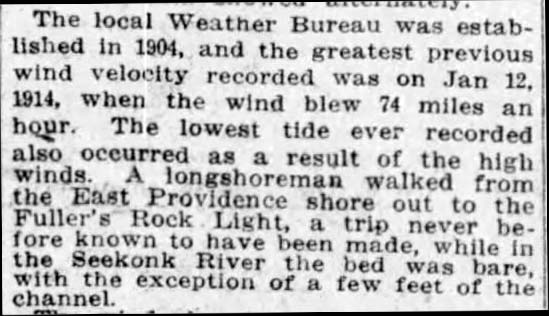
A strong winter storm hit Providence on December 15, 1915. The Weather Service recorded an 82 miles per hour. It was the strongest wind recorded up until that date. The lowest tide ever recorded in the Providence River also occurred that day. A longshoreman walked from East Providence to Fuller Rock Light, with out getting wet.
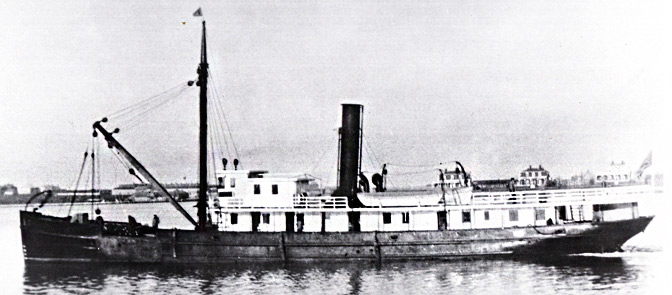
On February 5, 1923, the lighthouse tender Pansy arrived at Fuller Rock to replace its six acetylene tanks. The light had been changed from oil to acetylene when it was automated in 1918. The crew from the Pansy removed the old tanks and installed six new ones. Each tank was six feet long and weighed over 200 pounds. After the installation was completed, the crew returned to the Pansy for lunch.
After lunch, the crew returned to the light to make sure everything was all right. As they climbed the stairs to the light, it exploded throwing the men onto the surrounding rocks, injuring five of them. The damaged lighthouse burst into flames, completely destroying what was left of it. The explosion was so powerful it was heard a mile away.
| Lighthouse Tender Pansy |
|---|
 |
| Courtesy of Lighthouse Digest |
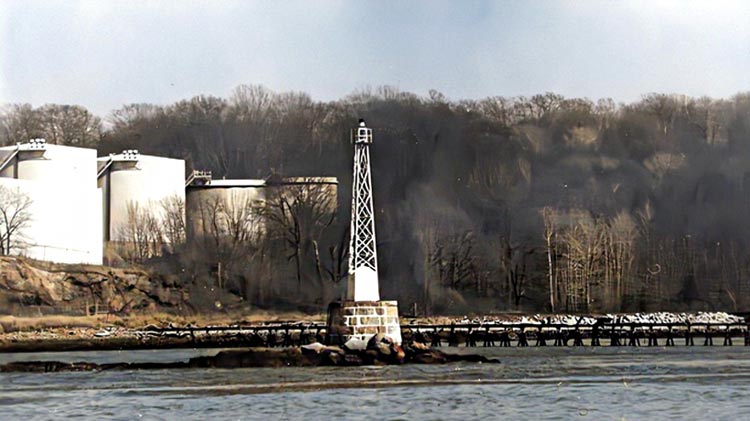
The Pansy rushed its five injured crewmembers to Providence for treatment. A buoy was placed near Fuller Rock as a temporary aid to navigation. A light on a skeleton tower was later erected on the granite pier.
In the early twentieth century, steamships carried passengers from New York to Providence every morning. On foggy mornings, mechanical fog signals on the other lighthouses in the Providence River would guide the ships up the river. Fuller Rock Lighthouse had a unique fog signal, a man with a horn. He would row out to the light before the ships arrived. This was a difficult task in the fog. He would use sound to find the light, listening for the waves breaking against the shore. He would row towards it only to find it was the Standard Oil pier half a mile south of the light or miss the light and would row to the other side of the river.
One he reached the light he would climb on to the base of the light and start blowing the horn until the ship coming up the river heard it. The ship blew its whistle indicating the horn has been heard. After that the ship would blow its whistle and he would blow the horn in response until it passed Fuller Rock.
This service was not provided by the government. Susan Morgan, who lived in a house near the light, paid men to blow the horn for over twenty years. Susan even blew the horn herself a few times when she couldn't find anyone else to do it.
| Fuller Rock Lighthouse Pre 1923 (colorized) |
|---|
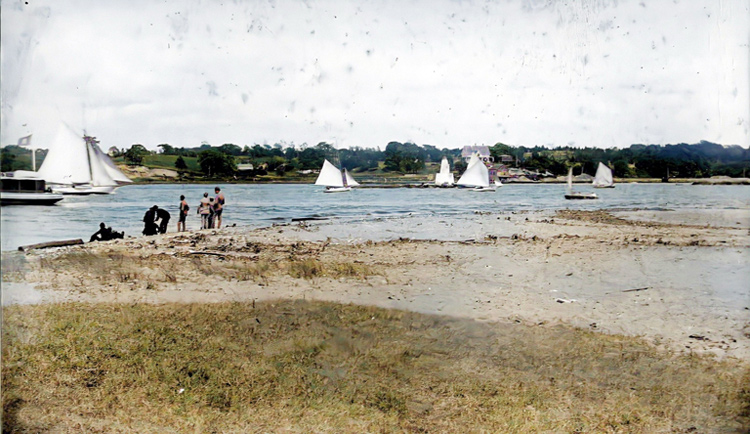 |
| "View of east shore- Kettle Point light, center", VM013_GF6401, Rhode Island Photograph Collection , Providence Public Library, Providence, RI licensed under CC BY-SA 4.0 |
| Fuller Rock Lighthouse 1950's |
|---|
 |